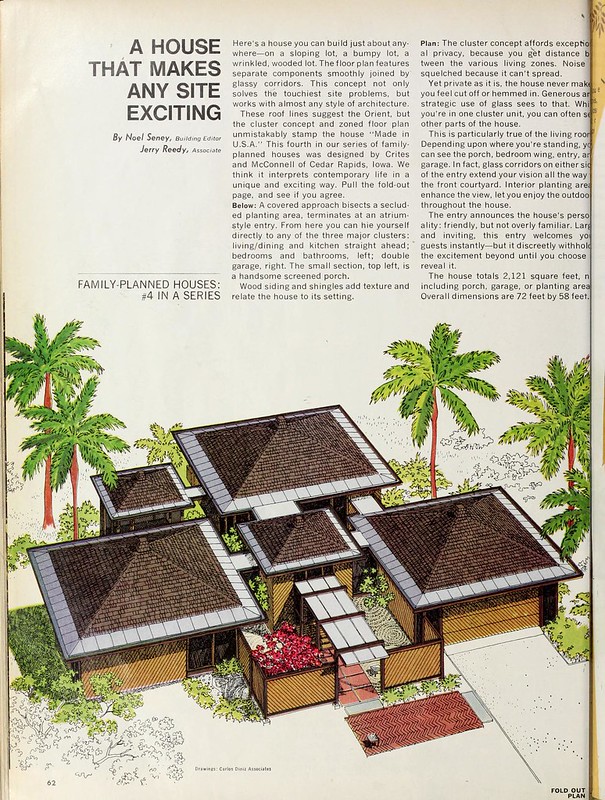
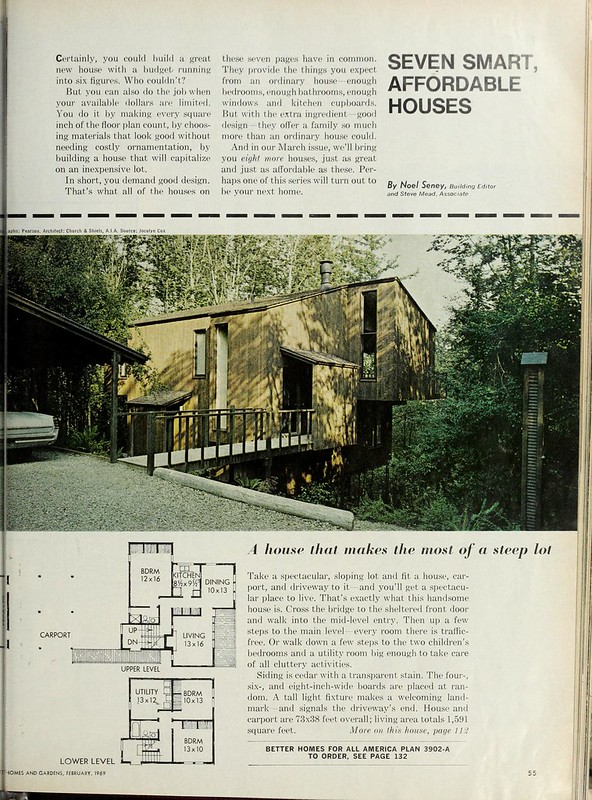
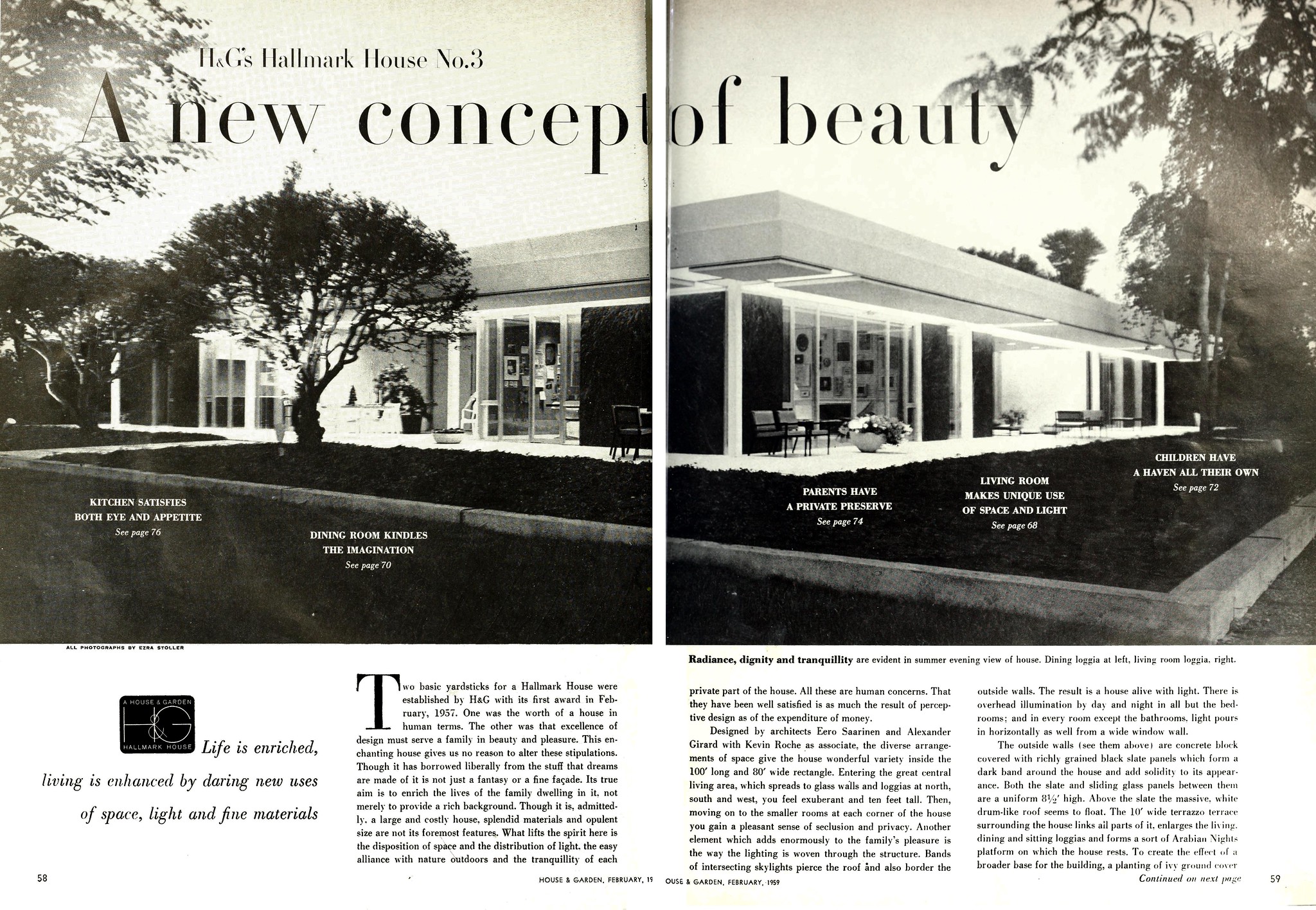
Was there ever a more optimistic time in the US of A than the 1950s? Seems like a lot of thought went into the swell future with push-button homes and jet-engined cars (some fly, some don’t) in the garage. Architect Paul Laszlo had his own vision of living in 2004 as seen from 1954:


Link:
TIME: Rich Man’s Architect
Once upon a time in mid-century USA, airports were neat places to see and experience. Not at all like today where you are subjected to a dreaded, purgatorian visit to the sterile lockdown. That gets you prepared for boarding the winged Greyhound bus…Oh well, I’m just getting wound up now, so let’s take a look at a trip around Idlewild (now Kennedy) Airport in New York back in 1961. These pics were taken by Dimitri Kessel for an article in LIFE magazine about Idlewild. Enjoy!


And here is the iconic TWA Terminal (now JetBlue Terminal 5) designed by Eero Saarinen under construction:


In a brilliant entry, Build LLC’s Build Blog has posted the ”10 Forgotten Lessons” that were fundamental to modern architecture in the Mid-Century.
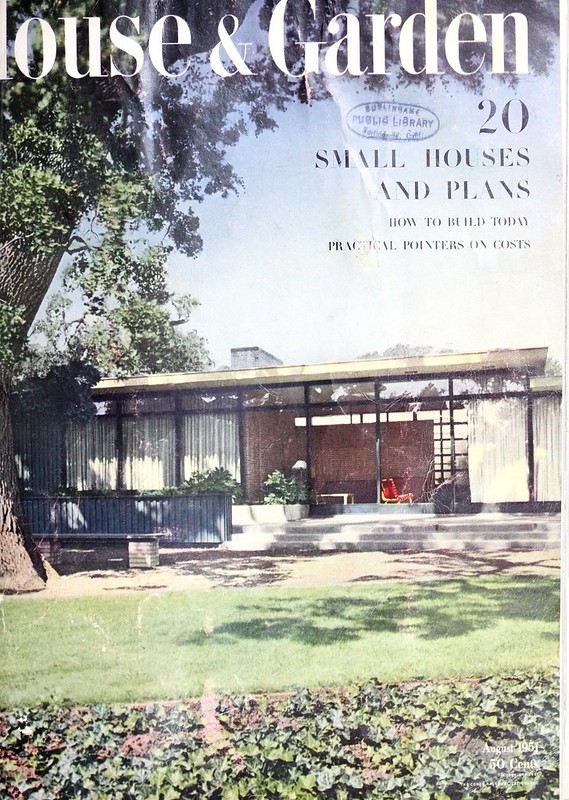
The lessons were taken from a tour of a well-preserved home designed by Paul Kirk (see another Paul Kirk house here). Here are a few of the 10 Lessons:
- Keep it simple.
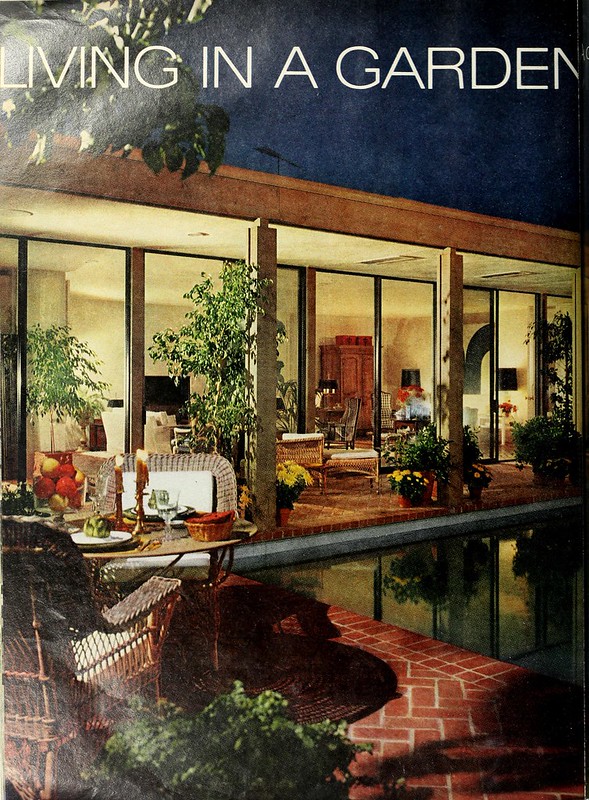
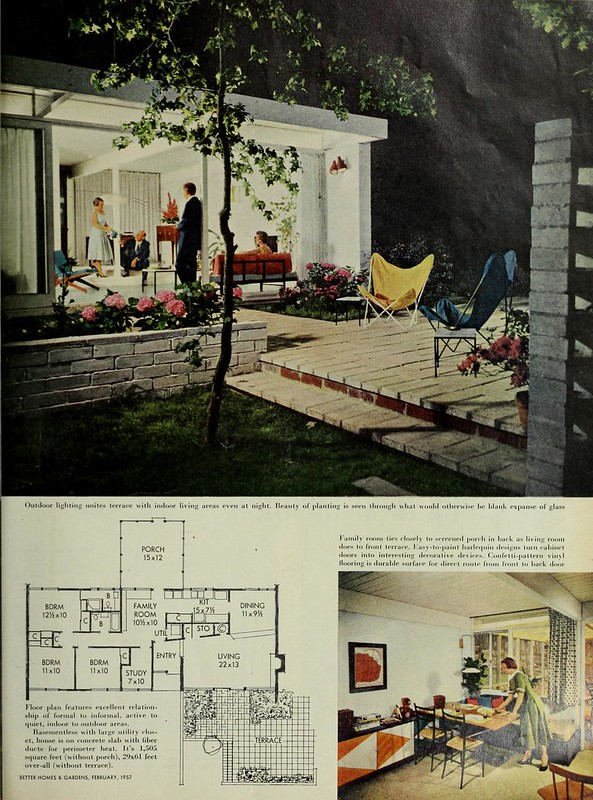
- Connecting the inside to the outside creates harmony with the site.
- Let nature do the work.
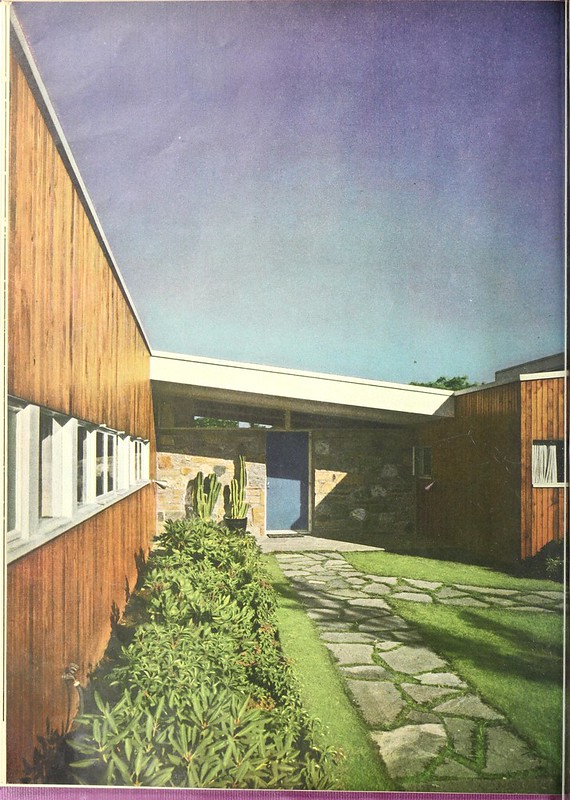
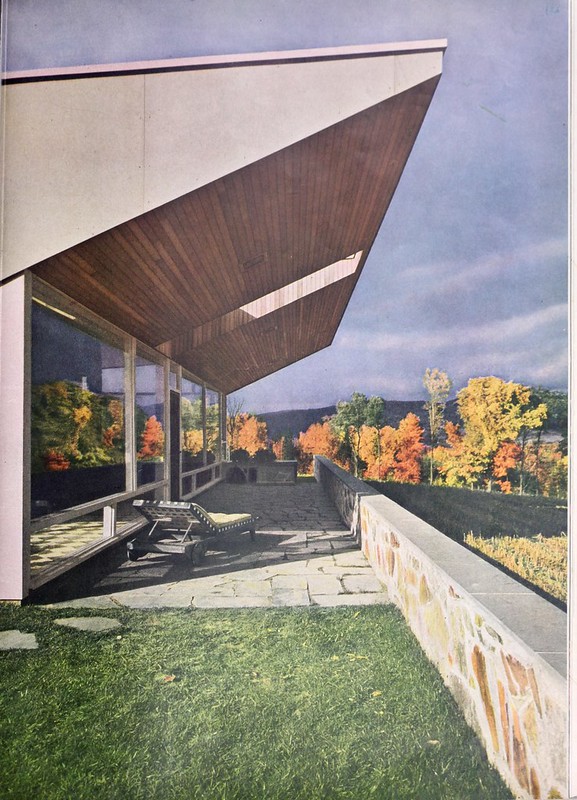
We think the pics below are good examples of these lessons.
From LIFE Magazine (1951):
Architect Bruce Goff, one of the few U.S. architects whom Frank Lloyd Wright considers creative, scorns houses that are “boxes with little holes.” But he likes circles, believing that a circle is “an informal, gathering-around, friendly form.” Working on this theory, he designed a house for the Albert Fords of Aurora, lll. which makes most modern houses look quaint.
The house consists of a huge, domed center circle, 166 feet around. and two semicircular bedroom wings, all shaped by steel arches made of standard Quonset ribs. At the base of the center sphere, which is built on three levels, is a curved cannel coal wall, treated against smudging and weathering. For sparkle, this wall is studded with ordinary playing marbles and with numerous 100-pound clusters of bright glass cullets, a hardened waste product periodically cleaned from glass furnaces.
Navy surplus rope covers the horizontal ceilings. Cypress siding, laid in a herringbone pattern, lines part of the domes and walls. There are no windows, so ventilation is provided by hinged louvres and ceiling vents. Chief hazards of the main living space are the glass walls, which carry out Goff’s theory of “space moving inside and out.” To keep guests from trying to follow suit Mrs. Ford is growing succulent plants in ditches outside the glass walls.
The house, which cost $64,000, delights its owners. Mr. Ford, who is a gas-company executive, likes the doorless carport (“No trouble now to put the car away”); Mrs. Ruth Van Sickle Ford, who is the director of the Chicago Academy of Fine Arts, is pleased to have a balcony studio where she can paint, a gallery where she can hang pictures and plenty of room where she can entertain-all in a house that requires little care. Friends and curious passers-by are often less delighted. While building was in progress so many people came to gape at what they variously called the “big apple,” “birdcage,” “dome” or “hangar” that the Fords posted a sign reading, “We don’t like your house either.”


Links:
MidCentArc Ford House Flickr Set
Bruce Goff bio w/More Links
Paul Ringstrom’s Ford House Set on Flickr
Scenographix, Ltd


See More Pics of the Beattie Residence on:

Designed by the Taliesin Associated Architects in Elm Grove, Wisconsin, this “Ultimate House” as declared by the Milwaukee Journal, opened in 1963. As you can see below, it still exists today.


Links:
Taliesin
Wesley Peters

“Early in Haertling’s career he was commissioned by University of Colorado psychology professor Theodore Volsky to design a house for his family of four on a steep hillside lot extending from a mountain stream in west Boulder. The lot featured views in all directions, half of them slightly upwards to the mountains. The Volskys were interested in taking advantage of these views in a dramatic living room situation. The prominent upward views suggested the upwards curving catenary roof form open to the high view areas while still maintaining interior scale. One gets a 360′ view from the curtain-less living room of the mountains to the west and south, and the plains and cityscape to the east and north. The steepness of the site was accommodated by lowering the house into the earth as much as possible to the rear and allowing light in by way of large lightwells. For basic economy a circular floor plan was conceived, which allowed for increased circulation in the smaller area of the circle and for larger rooms with minimum access distance.
The living room sits atop the circular form blossoming at the highest point from the ground that capitalizes on the excitement of the terrain. The lower level contains a recreation room and the entry. Upon ascending the stairs one emerges into an interior garden which not only surprises and delights, but also is very functional in that it serves also as a short cut between living areas.
During the construction of the Volsky house a dozen of the neighbors collaborated on a letter of protest regarding its “sheer grossness”, and voicing their concern over “a definite though incalculable loss of property values.” Within a year of the completion of the house Life Magazine printed a 6 page article on it in their Ideas in Houses section. In the following years it appeared on CBS-TV’s show “21st Century” hosted by Walter Cronkite, Schonen Wohnen, and L’Architecture D’aujourd’hui magazines. Since that time the Volskys have made a hobby of maintaining the house in its original form.”
- www.atomix.com/haertling/volsky.html

From LIFE Magazine, 1966:


More LIFE pics:


All Photos: Michael Rougier
Links:
Charles A. Haertling – Architect A.I.A.
Charles Haertling (Wikipedia)
Outside the box – The Rocky Mountain News
Work by the wonderful Charles Haertling!